
 Location :
The cosmogenic Beryllium-10 (10Be) and Beryllium-7 (7Be) have clear sources, stable environmental behavior, and significant differences in half-life. They are a class of natural environmental tracers with great potential for application, and have been applied in research on natural source stratospheric ozone input, aerosol generation and transport, and atmospheric circulation.
Micro/nano-plastics (MNPs) have been proven to be able to achieve long-distance transportation across regions and even continents through the atmosphere, and continue to be detected in remote areas such as the Tibetan Plateau and the Arctic where human activities occur. However, there is still a lack of direct observational evidence for the sources and cross atmospheric migration mechanisms of MNPs in high-altitude areas, especially whether stratospheric air is involved in the long-distance transport of microplastics has not been effectively verified.
Recently, a research group from the Institute of Earth Environment of the Chinese Academy of Sciences (IEECAS) introduced cosmogenic 10Be and 7Be into atmospheric MNPs. The researchers used accelerator mass spectrometry (AMS), pyrolysis gas chromatography/mass spectrometry (Py-GC/MS), Laser direct infrared imaging (LDIR), and numerical simulation as measurement and analysis techniques to systematically reveal the process of stratospheric air participation in long-distance transport of MNPs in high-altitude areas in Lhasa, southern Tibetan Plateau. A new method for synergistically tracing stratospheric air transport of MNPs using 10Be and 7Be was established, achieving quantitative identification of the cross layer migration process of new pollutants and providing a new technological path for the contribution of stratospheric transport that has been difficult to directly observe for a long time.
The researchers have found that the MNP mass concentration in the winter atmosphere of the southern Tibetan Plateau is 0.0059-0.11 μg/m3, mainly composed of polyethylene terephthalate (PET), polyvinyl chloride (PVC), and polycarbonate (PC), accounting for over 60% of the total mass. By analyzing the 10Be/7Be ratio changes, they observed typical atmospheric motion events of stratospheric air masses sinking and transferring to the surface in the Tibetan Plateau. The stratospheric air mass completes large-scale vertical transport from top to bottom within a month, significantly accelerating the deposition of MNPs in the upper atmosphere. The atmospheric retention time of MNPs in the stratosphere is shortened from 1-2 years to 1-3 months. Affected by this invasion, the dry deposition flux of MNPs in the southern Tibetan Plateau has increased by 3.5 times, and the daily average concentration of ozone in the region has increased by 34% simultaneously (~14ppm) (Fig. 1).
The researchers further analyzed and found that the strong westerly jet stream in winter promotes stratospheric air folding at the top of the troposphere over the Tibetan Plateau, pushing high-altitude air to sink to the near ground (Fig. 2). The atmospheric MNPs in high-altitude areas not only come from near ground emissions, but also play a key role in the sinking airflow in the stratosphere and cross-border long-distance transport. During the observation period, about 7% of the air masses that reached the sampling point came from the boundary area between the stratosphere and troposphere.
This study suggests that relying on the unique high-altitude terrain and atmospheric dynamic processes of the Tibetan Plateau, the atmospheric circulation system may accumulate and re diffuse MNPs during certain periods, forming a "secondary pollution source" (Fig. 2f). Beryllium isotopes serve as unique identification signals for stratospheric air masses, and continuously exploring their tracing value can help clarify the transport patterns of MNPs and other substances in the upper atmosphere.
This research demonstrates the broad prospects of extending it to the study of environmental tracing of typical emerging contaminants such as MNPs. In the future, the researchers will further construct a natural tracer system for pollutants based on cosmogenic nuclides, and apply it to the study of cross layer migration, long-distance transport, and environmental fate of different typical pollutants, providing new research tools for revealing global circulation mechanisms such as emerging contaminants and supporting precise prevention and control of emerging contaminants.
This work, published in Journal of Hazardous Materials, was supported by the National Natural Science Foundation of China.
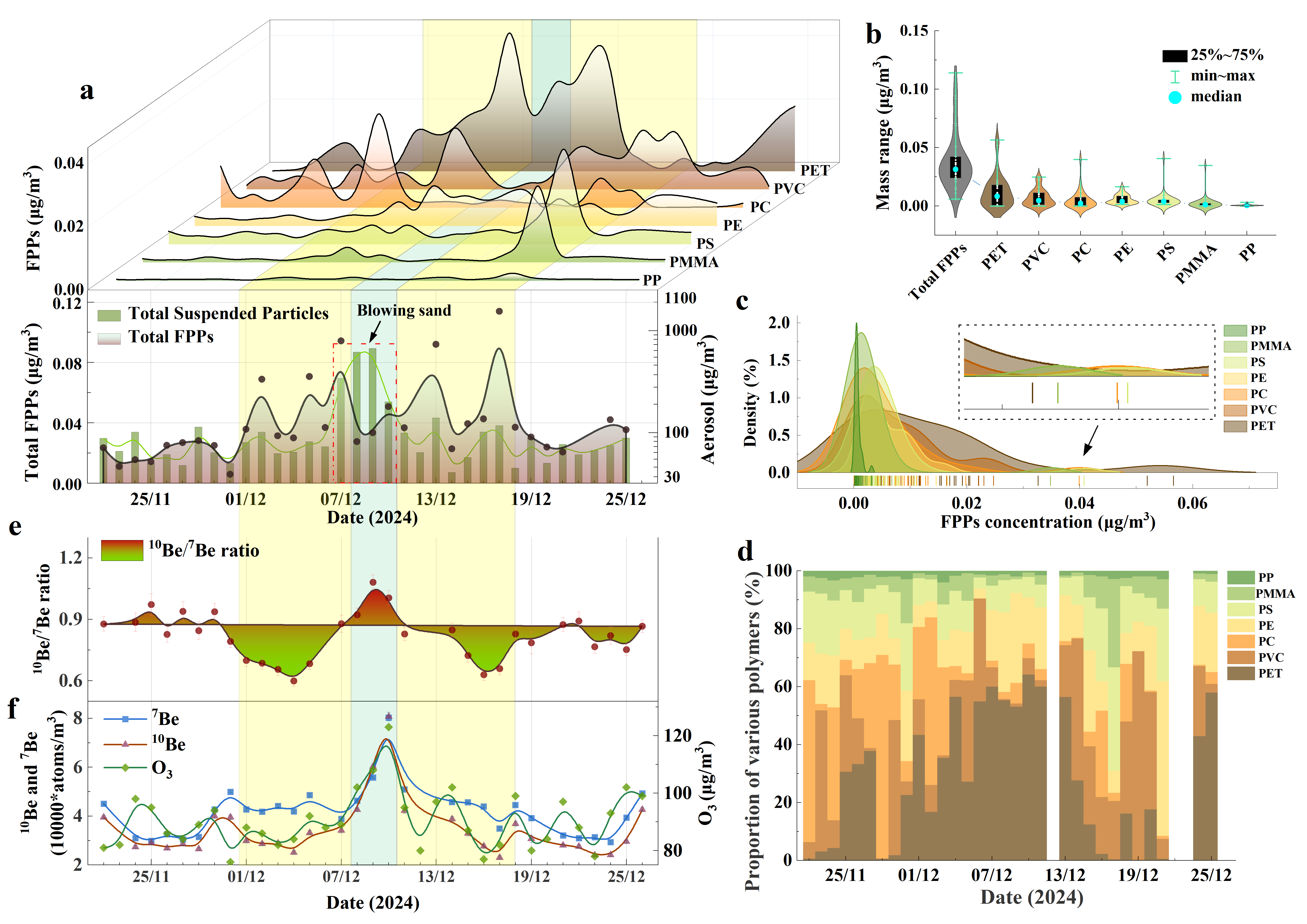
Fig. 1 Diurnal variation of atmospheric MNP characteristics, cosmogenic 10Be, 7Be, and ozone in Lhasa, TP, from Nov. To Dec. 2024. The shaded region (30th Nov. to 18th Dec.) marks the abnormal fluctuation period for total MNP concentrations, 10Be/7Be ratios levels, and ozone, incorporating the blue-shaded dust event (7th-10th, TSP: 200-1000 μg/m3). local time, UTC + 8.(Image by LIU Xuke, et al)

Fig. 2 Simulation and schematic diagram of atmospheric transport MNPs during the observation period. a, Atmospheric circulation around the TP and the topography around the sampling site. b, Time-varying curves of stratospheric tracers in the WRF-Chem model. The diagram in the upper left corner is a schematic diagram of the distribution of simulated points and the westerly jet stream. c, Meridional profile of WRF-Chem stratospheric tracer at the sampling point, 14:00 on 10th Dec. 2024 (UTC+8). d, Spatial distribution of WRF-Chem stratospheric tracer at typical time points on the Earth's surface. e. HYSPLIT backward trajectory clustering analysis of sampling site. f, Schematic diagram of how atmospheric vertical circulation promotes MNP transport. (Image by LIU Xuke, et al)
 © 2015 Institute of Earth Environment,CAS
 Address:No. 97 Yanxiang Road, Xi'an 710061, Shaanxi, China